Neweb
- SEO autopilot
- Web automation
- AI engine
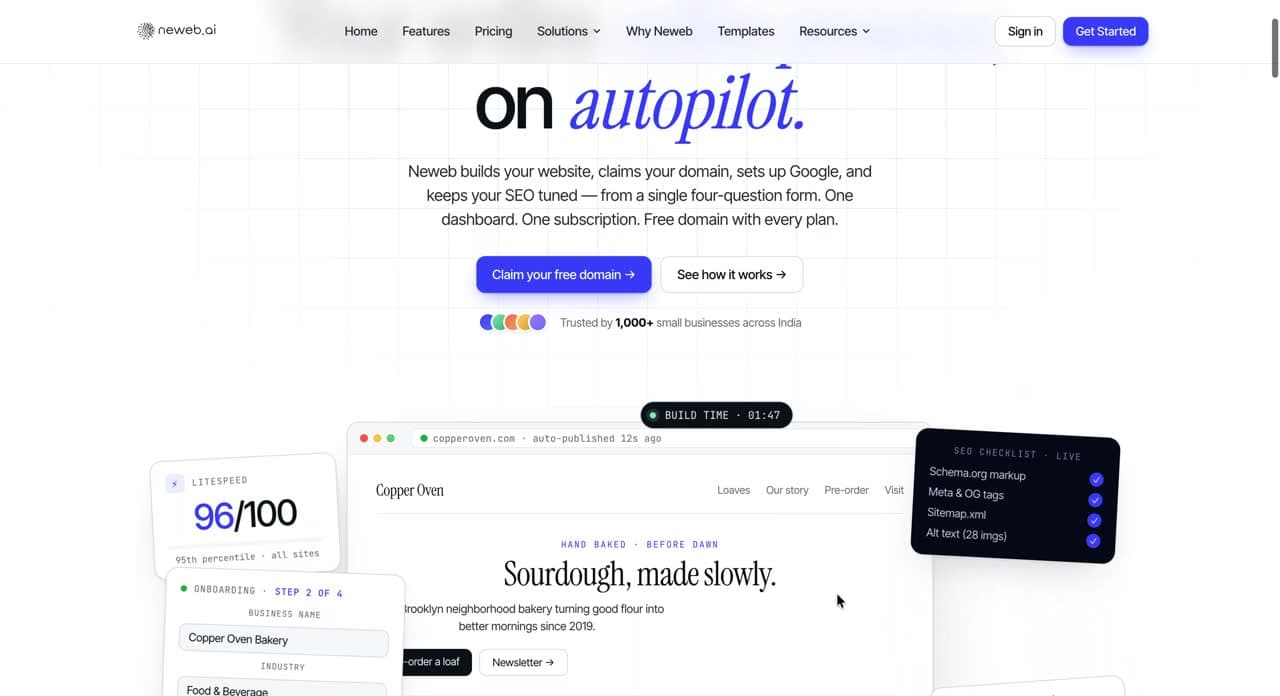
An AI-driven online presence manager that automates WordPress deployment, domain provisioning and Google Business Profile sync in 90 seconds.
Who it was built for
Built for
Neweb
Sells an online presence as a subscription: a website, a domain and a Google Business Profile, kept current for local businesses that have no interest in maintaining any of it.
The brief
Site builders lose people at the blank canvas, and a local business owner is not going to finish one between jobs. Neweb had to replace the build with an outcome — four questions, then a live site, inside two minutes.
What we delivered
Four questions, then a site
One source of truth for the details
SEO that keeps going
Speed by default
Where the growth comes from
Nobody abandons a form they finish
Found, not merely online
Agencies resell it
The business analysis
Neweb is a bet that local businesses do not want a website builder. They want a website, and the builder is the obstacle. Everything commercially interesting about this product follows from that: if the outcome arrives in ninety seconds, the onboarding funnel stops leaking, and if the same data keeps Google and the site in agreement afterwards, the subscription has a reason to renew. Those are two different businesses stacked on one intake form, and they fail for different reasons.
- CMS share held by WordPress
- 60.7%
Source · W3Techs data, October 2025, reported by Search Engine Journal
- Questions before anything is built
- 4
Model · Counted from the intake flow documented in this case study.
- Surfaces kept in sync from one record
- 3
Model · Counted from the delivered scope in this case study.
The problem is the blank canvas, not the tooling
Site builders are good products that most of their signups never finish, because they hand a local business owner an empty page and a design decision. Neweb's intake asks four questions and makes none of the decisions available to the customer. That is a conversion mechanism disguised as a limitation, and it is the whole reason the ninety-second claim matters commercially: for a self-serve product with no sales team, onboarding completion is the funnel.
Ninety seconds, start to finish
Four questions
Domain claimed and pointed
- ↳ Preferred domain taken → alternatives offered inline
Site built from an industry layout
Sync the business profiles?decision
- ↳ Profile already claimed → ownership verification queued
- ↳ Verification pending → site ships, sync retried
Autopilot on
Time to a live site, by route
Brief, design rounds, content requests. The highest quality, and the reason most local businesses never start.
Elapsed rather than active time. The work is spread across evenings, and a large share of drafts are abandoned.
One session, no design decisions, and the outcome exists before the owner's attention does anything else.
Model · Our estimates of elapsed calendar time for each route, from decision to a public URL. Illustrative comparison — no completion-rate data was shared with us.
Why the recurring half is the real product
A website is a one-off purchase that people resent paying for twice. Presence is not. The commercial distinction between Neweb and a site builder is that the thing being sold monthly is agreement between the site, Google and Bing — the details that go stale on their own and cost a business calls when they do.
| Half of the product | What the customer is buying | Cancellation risk |
|---|---|---|
| The build | A site that exists, in ninety seconds | Very high once it exists — nothing left to buy |
| The sync | Hours, photos and phone numbers correct in three places at once | Low, because the drift resumes the moment it stops |
| The SEO passes | Schema, meta tags and sitemaps revisited weekly rather than at launch | Low, and the effect is invisible until it is withdrawn |
| The performance work | Pages that load on a phone on mobile data | Low, but hard for the customer to attribute |
Where a subscription's perceived value sits after month one
- The only line the customer can verify themselves by searching for their own business.
- Highest value, lowest visibility. The reason churn analysis for this product is hard.
- Table stakes, and priced as such by every competitor.
- Enormous value in month zero, close to none by month three.
Model · Our weighting of the four delivered capabilities by their contribution to renewal, based on which of them keep producing value after launch.
Performance is a local-search argument
Speed is in the delivered scope because of who is on the other end: someone searching for a trade on a phone, on mobile data, with a competitor one result away. Google's own threshold for a good Largest Contentful Paint is 2.5 seconds 1, and the deployed sites are built with LiteSpeed and edge caching to sit well under it. On a fleet of automatically generated sites this has to be structural rather than per-site tuning — nobody is going to hand-optimise the four hundredth restaurant.
The stack, by responsibility
Intake and dashboard
- Next.js 14
- TypeScript
- Tailwind CSS
- Framer Motion
Orchestration
- Node.js
- Express
Site engine
- WordPress
- Generated block layouts
- LLM-written copy
Presence integrations
- Google Business API
- Bing Places
- Schema markup
- Sitemaps
Delivery
- LiteSpeed
- Edge caching
- Cloudflare
What we would watch
| Risk | Why it bites | Early indicator |
|---|---|---|
| Platform dependency on Google | The retention half of the product is an integration with a surface Google controls, prices and redesigns at will | Verification or API changes arriving faster than the sync can be updated |
| Generated-content commoditisation | If a hundred local sites in one trade read alike, search stops rewarding them and the SEO promise weakens | Ranking performance diverging between customers on the same industry layout |
| Invisible value in the recurring line | Customers cannot see SEO passes happening, and cancel things they cannot see | Churn concentrated at the month three to six mark rather than at month one |
References
- 1.Largest Contentful Paint (LCP) · web.dev, Google
- 2.Top 10 Content Management Systems (W3Techs data, October 2025) · Search Engine Journal
Ninety seconds, start to finish
Four questions
Business, location, industry, name. No design decisions.
Domain claimed
Provisioned and pointed without leaving the flow.
Site built
Industry-specific block layout, filled with generated copy.
Profiles synced
Google Business Profile and Bing Places populated from the same data.
Autopilot on
Weekly SEO passes and performance monitoring start immediately.
Who it is for
Local businesses
Agencies and studios
Multi-location franchises
Reference
The engineering write-up
Recommended case studies



Want the version of this built for your business?
Fifteen minutes with the people who shipped it. No deck, no account manager.