Callease AI
- Automation
- Voice AI
- B2B
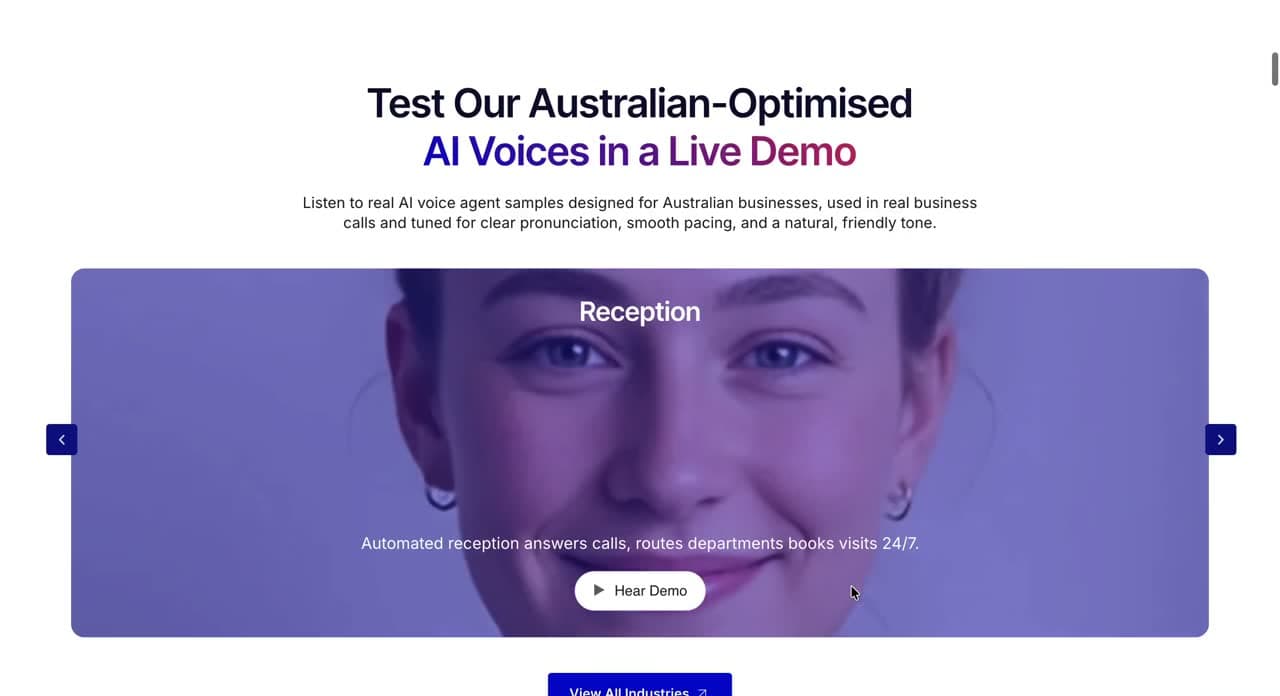
Automated phone calls handled by human-like AI voice agents, built for Australian businesses.
Who it was built for
Built for
Callease AI
Sells AI phone agents to Australian businesses on subscription. Their customer is the clinic, agency or trades business that keeps missing calls.
The brief
For those businesses a missed call is a lost job, and voicemail does not recover it. The agent had to hold a normal conversation, put work into a real calendar, and be set up by the customer without a developer in the room.
What we delivered
Agents the customer configures
Conversation that keeps pace
Calls that end in a booking
Local numbers
Transcripts and call analytics
Where the growth comes from
The phone is answered at 9pm
People only take qualified calls
One agent, then fifty
The business analysis
Callease sells a subscription against a cost its buyers already pay and cannot see: the enquiry that rang out. The commercial question is therefore not whether an AI agent can hold a conversation — several vendors have settled that — but whether the recovered call is worth more than the subscription, and whether one customer can be onboarded without an engineer. Everything below is an attempt to answer those two questions with figures that can be checked.
- Employing businesses in Australia
- 994,178
Source · Australian Bureau of Statistics, Counts of Australian Businesses
- Reply latency target
- < 500ms
Model · Design target set during the build, not a measured production average.
The market it sells into
The category Callease competes in is young enough that its size is still being argued about, and the forecasts differ by an order of magnitude depending on whether a research house counts voice agents as their own market or as a slice of conversational AI. Taking the narrowest credible definition — software whose product is an autonomous voice agent on a telephone line — Grand View Research values the global market at USD 2.5bn in 2025 and forecasts USD 35.2bn by 2033, a 39.0% compound annual growth rate, with North America holding 38.1% of 2025 revenue 1.
AI voice agents — global market, USD billions
- $2.5bn
- $3.5bn
- $35.2bn
- 2025
- 2026
- 2033
Hollow columns are the published forecast, not a measurement.
The Australian Bureau of Statistics counted 2,729,648 actively trading businesses at 30 June 2025, of which 994,178 were employing 2; 97.3% of all Australian businesses had fewer than twenty staff 3. Those two facts set the shape of the product. The addressable buyer is small, has no IT department, and the person who would configure an AI agent is the same person answering the phone — which is why "the customer configures it, not us" is a commercial requirement rather than a nicety.
Serviceable market, narrowed step by step
ABS, 30 June 2025. Includes sole traders with no staff and no inbound call volume.
ABS. Someone is paid to be reachable, so an unanswered call has a cost attached to it.
Health, trades, real estate, hospitality, professional services. Assumption, not a published figure.
Willing to route a live line to software today. Assumption.
Model · ABS business counts, then two stated assumptions (30% sector fit, 10% near-term willingness). The first two rows are published data; the last two are ours and are labelled as such.
The buyer's problem, in numbers
The best-documented study of what actually happens to small-business phone calls tracked 85 businesses across 58 industries: 37.8% of inbound calls were answered by a person, 37.8% went to voicemail, and 24.3% received no response at all 4. The important part is the last figure. A voicemail is a weak recovery path; no response is none.
Where an inbound call to a small business ends up
- The only outcome that can convert today.
- Recoverable in principle, rarely recovered in practice.
- Not even a voicemail option. Unrecoverable without automation.
Source · 411 Locals inbound-call study, as reported by Zadarma
The alternative to software here is people, and people are the reason the problem persists. Median weekly earnings for a receptionist in Australia are AUD 1,175 5, or roughly AUD 61,100 a year before superannuation, penalty rates or cover for leave. Answering a phone across all 168 hours of a week rather than a 38-hour ordinary week takes about 4.4 of those people.
That number is why the pricing conversation is short. A subscription does not have to beat a receptionist on quality of conversation to be worth buying. It has to beat the marginal cost of the hours a receptionist is not there, which is where most of the missed calls are.
Where the revenue comes from
Three revenue mechanics sit inside the build, and they are not equally valuable. Ranking them is the difference between a product that grows and an agency that bills.
| Mechanic | What it does commercially | Depends on | Ceiling |
|---|---|---|---|
| Answered after-hours calls | Converts an enquiry that previously reached voicemail into a booking | Reliable telephony, local caller ID | Bounded by the buyer's own call volume |
| Qualification before a human | Moves paid sales time onto conversations already worth having | Grounded reasoning over a knowledge base | Bounded by headcount saved |
| Self-serve agent configuration | Turns onboarding from a project into a setup task | Persona, knowledge and rules as data, not code | The one that scales |
Where engineering effort went, by commercial purpose
- Persona, knowledge base and business rules as structures a customer edits.
- Keeping audio, transcription, reasoning and speech in step.
- The part that turns a conversation into a booked, recorded outcome.
- Evidence for tuning scripts, and the first place a failure shows up.
Model · Our own apportionment of build effort across the four workstreams, reconstructed after delivery. Directional, and rounded.
The constraint the whole product is built around
Everything difficult about this system comes from one number. A caller will tolerate roughly half a second of silence before assuming the line is dead or talking over the reply. That budget has to contain the full round trip — audio in, transcription, model reasoning against the customer's knowledge base, speech synthesis, audio out — and any component that blows it takes the conversation with it.
The stack, by responsibility
Configuration surface
- Next.js
- TypeScript
- Tailwind CSS
- Call analytics
- Agent setup
Orchestration
- Node.js handlers
- Voice webhooks
- Synthflow call flows
Transient state
- Redis
- Session state
- Retry-safe jobs
System of record
- MongoDB
- Transcripts
- Call logs
- Customer config
Business systems
- CRM
- Calendar
- Payments
One inbound call, end to end
Call lands on a local Australian number
Session opens, agent context loaded
Speech to text, then grounded reasoning
Can the agent close this itself?decision
- ↳ Out of scope → hand to a human
- ↳ Caller asks for a person → transfer
- ↳ Low confidence → capture details and escalate
Live availability checked, meeting booked
CRM record written, follow-up triggered
Transcript stored and scored
What we would watch
An honest analysis names the ways the model breaks. These are the three that matter for this one, and none of them are engineering problems.
| Risk | Why it bites | Early indicator |
|---|---|---|
| Vendor concentration in voice | Call-flow execution sits with one provider, so its pricing and its latency are the business's pricing and latency | Gross margin per minute moving without a change on our side |
| Regulatory disclosure | Rules on disclosing automated callers are tightening across jurisdictions; a mandated disclosure at the top of every call changes conversion | Consent and disclosure requirements entering telecommunications guidance |
| Configuration debt | The moat is that customers configure agents themselves. Every exception built for one customer erodes it | Support requests that end in a code change rather than a settings change |
References
- 1.AI Voice Agents Market Size And Share Report, 2026–2033 · Grand View Research
- 2.Counts of Australian Businesses, including Entries and Exits · Australian Bureau of Statistics
- 3.Number of small businesses in Australia · Australian Small Business and Family Enterprise Ombudsman
- 4.The Hidden Cost of Missed Calls (411 Locals inbound-call study) · Zadarma
- 5.Receptionist — median weekly earnings · Victorian Government careers data
How an agent goes live
Persona
Tone, accent and the boundaries of what it will discuss.
Knowledge
Company specifics and FAQs loaded into the agent's context.
CRM
Connected so a qualified call creates a record.
Calendar
Availability checked and meetings booked directly.
Scripting
The conversation tuned to one business goal per agent.
Number
A local Australian line provisioned and routed.
Launch
Live monitoring, then tuning from real transcripts.
Who it is for
Support teams
Sales and marketing agencies
Booking-led businesses
Reference
The engineering write-up
Recommended case studies

Want the version of this built for your business?
Fifteen minutes with the people who shipped it. No deck, no account manager.