OSMO
- AI integration
- Microservices
- Marketing tech
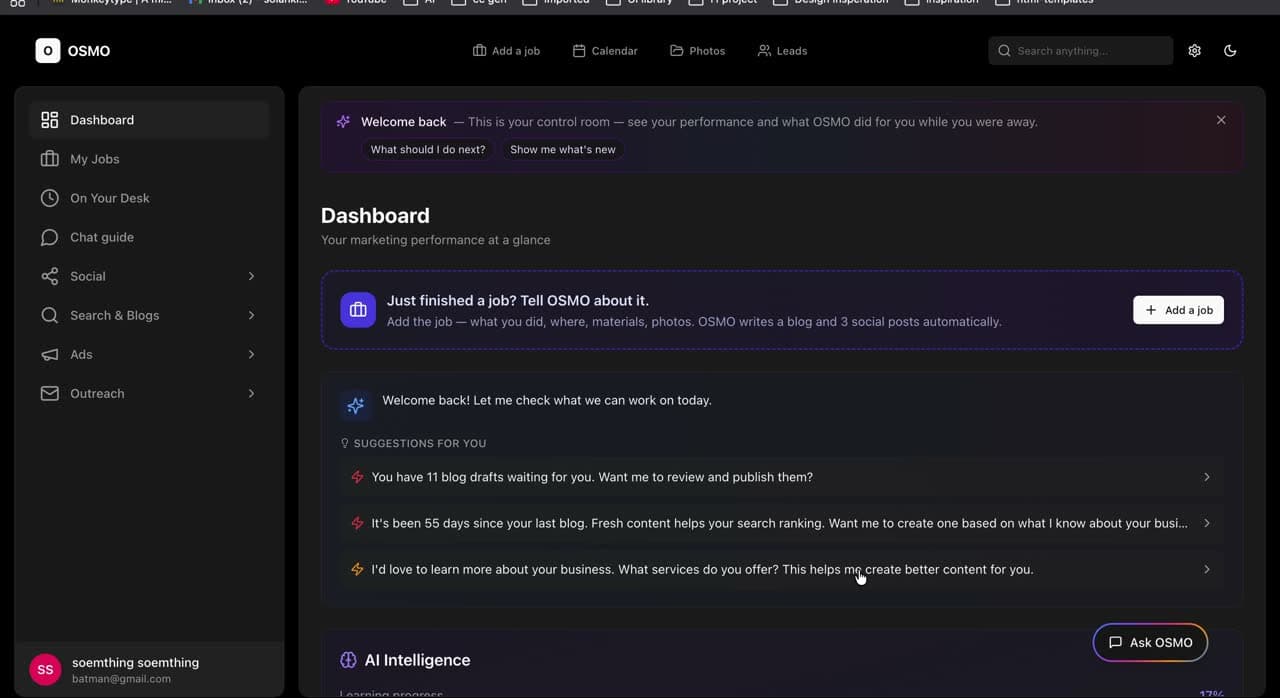
A marketing automation suite that centralises online marketing workflows across social networks, search engines and direct outreach.
Who it was built for
Built for
OSMO
Sells one marketing platform to owners and agencies currently paying for five: content, scheduling, outreach, SEO and paid ads.
The brief
Consolidation only sells if each engine stands on its own. Every module had to be strong enough that cancelling the incumbent tool is an easy decision rather than a compromise.
What we delivered
Five engines, one dashboard
AI that produces publishable work
Scheduling that does not stall
Numbers in the same place as the work
Where the growth comes from
One subscription replaces several
Agencies arrive with accounts attached
The work stays inside the product
The business analysis
Consolidation plays are the hardest kind of software to sell, because the customer has to be persuaded to cancel five things they already understand. OSMO's pitch is one platform and one invoice in place of content, scheduling, outreach, SEO and ad tools bought separately. That comparison only survives contact with a buyer if every module is good enough to replace its incumbent outright — because a consolidation that leaves two subscriptions running has not consolidated anything, it has added a sixth.
- Average SaaS applications per company
- 130 → 112
- Engines behind one navigation
- 5
Model · Counted from the delivered scope in this case study.
- Runtimes, deliberately
- 2
Model · Architectural fact, from the build described in this case study.
Sprawl is real, and the numbers describing it are unreliable
Every consolidation pitch cites a SaaS sprawl statistic, and almost every one of those statistics is measuring something slightly different. BetterCloud recorded the first decline in over a decade in application counts, from a 2022 peak of 130 per company to 112 in 2023 — a 14% fall 1. Other trackers, counting licences rather than sanctioned applications, report figures well above that and rising 2.
The stack OSMO is asking a buyer to cancel
Spend history, conversion tracking and optimisation data all live in the incumbent. Migrating loses the learning.
Historical ranking and backlink data is the moat. A new tool starts with no history.
Sequences and sender reputation are portable in principle, painful in practice.
Little accumulated state. The easiest beachhead, which is why the AI editor matters.
Almost no switching cost beyond reconnecting accounts.
Model · Our assessment of switching cost per category, based on how much accumulated customer data each incumbent holds. Judgement, not survey data.
The two revenue mechanics are not equal
One subscription replacing several is the pitch. Multi-client agency management is the business. Those are different mechanics with different economics, and confusing them is how consolidation products end up with high churn and a good demo.
| Mechanic | What it changes | Economic character |
|---|---|---|
| One platform instead of five | A smaller stack and one invoice | Wins the trial, loses to any gap in module quality |
| Agency multi-client management | One signup carries many client accounts | The compounding one — expands with the agency and is expensive to unwind |
| Work happening inside the product | Editor, calendar and reporting in one place | Retention, because leaving means rebuilding a workflow |
Where the durable revenue sits
- Each new client the agency wins is expansion revenue with no new sale attached.
- Calendars, drafts and reporting history accumulated in one place.
- The volume segment. Lowest expansion, highest churn.
Model · Our weighting of the three revenue mechanics documented in this case study by expansion potential and switching cost. Illustrative — no customer data was shared with us.
Where the architecture earns its complexity
Five engines behind one navigation is a lot of surface area, and the temptation is a single application that does all of it. The build resists that in two specific places, and both are commercial rather than aesthetic decisions.
The stack, by responsibility
Application shell
- Next.js 16
- React 19
- TypeScript
- Tailwind CSS v4
Working surfaces
- Tiptap
- FullCalendar
- ApexCharts
- React Query
- Redux
Platform services
- Node.js
- Express
- Socket.io
AI services
- Python
- FastAPI
- Azure AI GPT-4o
- Runware
Data and queues
- PostgreSQL
- MongoDB
- Redis
Channels and payments
- Meta
- Google Ads
- X
- Stripe
- Razorpay
One campaign, across five engines
Draft created in the editor
Scheduled on the calendar
Queued for dispatchdecision
- ↳ Channel rate limit → retried on backoff, not failed
- ↳ Token expired → account flagged, remaining channels still go out
Outreach sequences run
Performance beside the work
What we would watch
| Risk | Why it bites | Early indicator |
|---|---|---|
| The weakest module sets the price | A consolidation bundle is judged on its worst engine. One thin module and the buyer keeps an incumbent, which invalidates the whole pitch | Customers using four of five engines and still paying a competitor |
| Channel API dependency | Five outbound platforms, each of which changes its API and its policy on its own schedule | Engineering time spent on channel maintenance outgrowing time spent on features |
| AI cost per active account | Generation is a variable cost that scales with usage, and heavy agency accounts are the most valuable and the most expensive | Gross margin falling as agency seat count rises |
References
- 1.The number of SaaS applications at companies declined for the first time in over a decade · BetterCloud State of SaaSOps, via PR Newswire
- 2.Company tech stack size — SaaS applications per business · Vertice
Who it is for
Owners and founders
Agencies
Creators and SEO specialists
Reference
Recommended case studies

Want the version of this built for your business?
Fifteen minutes with the people who shipped it. No deck, no account manager.