Hotel Feasibility Study
- Financial modelling
- Dashboard
- Reporting
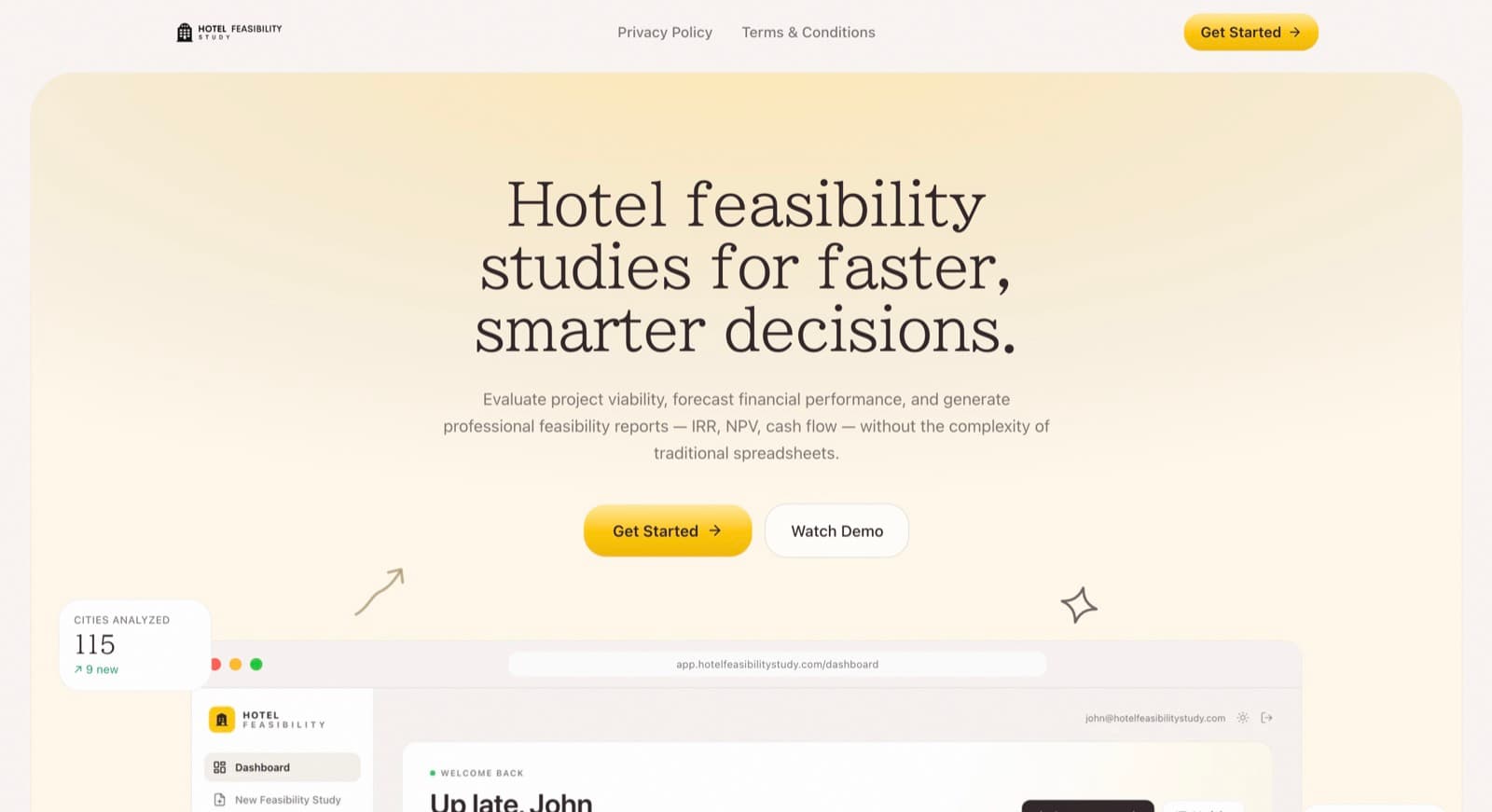
Evaluate project viability, forecast financial performance and generate professional feasibility reports — IRR, NPV, cash flow — without the complexity of traditional spreadsheets.
Who it was built for
Built for
Hotel Feasibility Study
A SaaS product for the developers and consultants who decide whether a hotel project is worth building, and who have to prove it to a lender.
The brief
That decision normally lives in a spreadsheet only its author can operate, and it has to be rebuilt for every site. The product turns the model into software: inputs in, IRR, NPV and cash flow out, and a report at the end that a bank will read.
What we delivered
The financial model as a product
Reports built for third parties
Numbers read as charts
Where the growth comes from
It sells a decision, not a tool
Consultants bill sooner
The business analysis
This product competes with a spreadsheet, and the spreadsheet is winning almost everywhere. That is the commercial problem worth analysing: not whether the maths can be put into software — it obviously can — but why an industry that routinely commits two hundred million dollars on the strength of a workbook keeps choosing the workbook. The answer is that the spreadsheet is trusted, and trust is what a feasibility product has to earn before it can sell anything.
- Median US hotel development cost per room
- $213,000
- Cell error rate in spreadsheet development
- 1–6%
Source · Panko, The Cognitive Science of Spreadsheet Errors (HICSS)
- Audiences for one output
- 3
Model · Counted from the audiences documented in this case study.
The sums being checked are very large
Hotel feasibility is a high-stakes, low-frequency decision, and that combination is what makes the incumbent tool so hard to displace. HVS's survey of 2025 US construction budgets puts median development cost at $213,000 per room, with luxury builds above $1.6m per key 1. A modest hundred-room select-service project is therefore a twenty-million-dollar commitment, and a large one is an order of magnitude beyond that.
What a feasibility study is deciding, at HVS median cost
The common case. A single wrong assumption here is worth more than the software costs for a decade.
HVS reports luxury exceeding $1.6m per key. At that end the study is a rounding error against the risk.
Model · Room counts chosen by us, multiplied by HVS's published median of $213,000 per room and its stated luxury figure of $1.6m per key. Arithmetic, not a survey.
The case against the spreadsheet, stated properly
The honest version of this argument is not that spreadsheets are bad. It is that they are accurate per cell and unreliable per model. Ray Panko's collation of spreadsheet audits found errors in 84% of 163 operational spreadsheets, and the four most recent studies at the time — using stricter methods — found errors in 91% of the 54 they inspected 23. The underlying cell error rate is only 1% to 6%, which is precisely why the problem persists: nobody's individual work feels wrong 4.
Share of audited spreadsheets found to contain errors
- 84%
- 91%
- 163 audited
- 54 audited, stricter
Source · Panko, Audits of Operational Spreadsheets; EuSpRIG conference paper
That is the entire product thesis, and it is a governance argument rather than a productivity one. Structured inputs and a fixed calculation engine mean the maths is identical on every project and nobody is auditing formulas. What the buyer gains is not speed. It is the ability to stop checking.
Where the revenue comes from
| Mechanic | What the buyer is paying for | Why it holds up |
|---|---|---|
| A repeatable model | The same engine on every site, so analysis stops being bespoke | Consultants are judged on turnaround as much as on rigour |
| Lender-ready reporting | A document formatted for the audience that decides, not for its author | The output is an input to a funding conversation, which is where the value is |
| Charts over cells | A forecast a room of stakeholders can read together | Nobody presents a workbook to an investment committee |
What the deliverable is actually for
- The artefact that supports the funding conversation. Remove it and the product is a calculator.
- Removes formula risk and the rebuild-per-site tax.
- How the numbers get presented and argued about in a room.
Model · Our weighting of the three delivered capabilities in this case study by their contribution to the purchase decision.
From site assumptions to a document a bank will read
Structured inputs
The model runs
Does the project clear the hurdle?decision
- ↳ Marginal → assumptions revisited, not the formulas
- ↳ Fails → the cheapest possible outcome, reached early
Charted for the room
Report issued to third parties
The shape of a financial-model product
Input capture
- Structured forms
- Validation
- Assumption sets per project
Calculation engine
- IRR
- NPV
- Cash flow projection
- Ramp-up curves
Presentation
- Performance dashboard
- Cash-flow visualisation
Reporting
- Feasibility report generation
- Third-party formatting
What we would watch
| Risk | Why it bites | Early indicator |
|---|---|---|
| Model trust | Consultants displace a workbook they built and understand. A single unexplained variance against their own model ends adoption | Users exporting to a spreadsheet to check the output rather than to present it |
| Assumption rigidity | A fixed engine is the product's main advantage and its main limitation. Unusual capital structures are where feasibility work is hardest | Feature requests that are really requests for a formula override |
| Low purchase frequency | Feasibility studies are episodic, so a seat licence idles between projects and gets cancelled | Renewal conversations that hinge on how many studies were run last year |
References
- 1.U.S. Hotel Development Cost Survey 2026 · HVS
- 2.Audits of Operational Spreadsheets · Ray Panko, University of Hawaii
- 3.Reducing Overconfidence in Spreadsheet Development · EuSpRIG
- 4.What We Know About Spreadsheet Errors (revised) · Ray Panko, arXiv
Who it is for
Hotel developers
Feasibility consultants
Lenders and investors
Recommended case studies
Want the version of this built for your business?
Fifteen minutes with the people who shipped it. No deck, no account manager.