HRMS AI CRM
- AI scoring
- B2B software
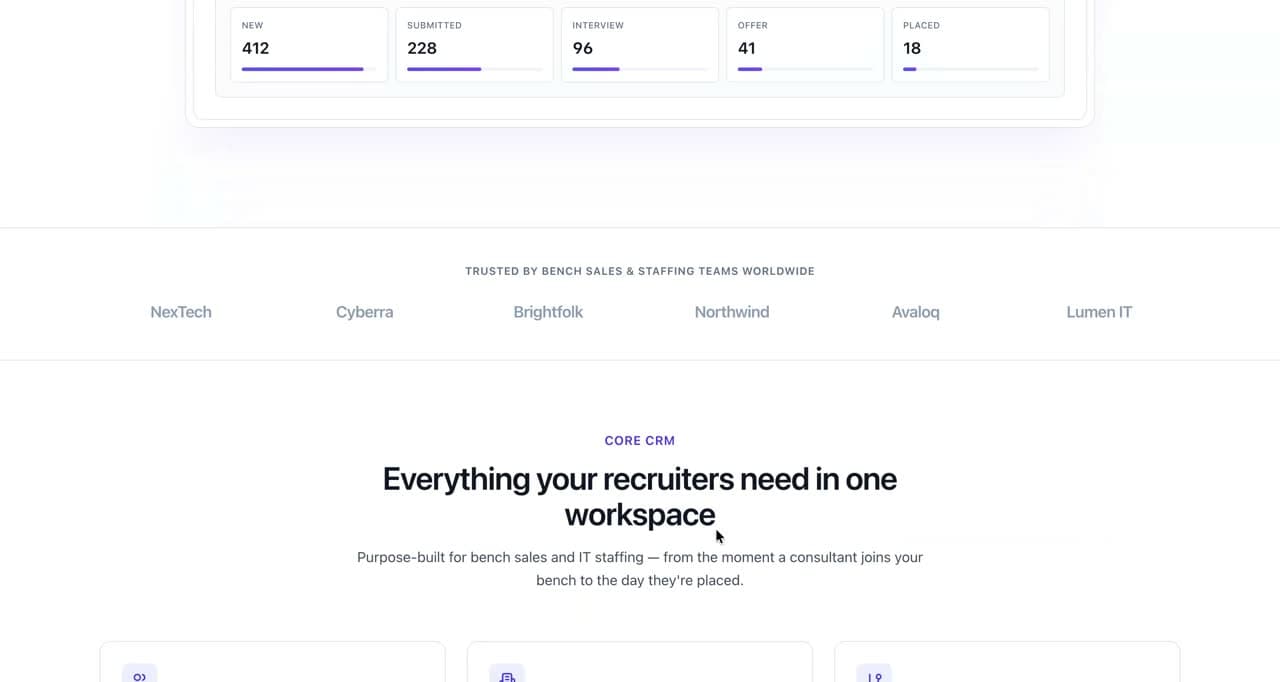
An AI-powered CRM built specifically for bench sales and HR management.
Who it was built for
Built for
HRMS AI CRM
Sold to IT staffing firms and bench sales teams, whose revenue depends entirely on how fast an available consultant gets placed.
The brief
A consultant sitting on the bench costs money every day they are not billing. The platform's only real job is to shorten the distance between an open requirement and the right person for it.
What we delivered
Resumes read automatically
Ranked before anyone opens a profile
Search that answers immediately
Desk and pocket in sync
Where the growth comes from
Days off the bench
More requirements per recruiter
The pipeline is visible
The business analysis
Bench sales is one of the few businesses where the cost of a slow decision can be calculated to the day. A consultant not billing is a consultant costing money, and every day between an open requirement and a submitted candidate is a day of that loss. This platform has exactly one commercial job, and the analysis below is an attempt to size it honestly: how much of the delay is actually removable by software, and which removed step is worth the most.
- What time to fill measures
- Requisition to accepted offer
- Manual steps removed before review starts
- 2
Model · Counted from the delivered scope in this case study.
- Shared state across desk and pocket
- 1
Model · Architectural fact, from the build described in this case study.
The metric this product is sold against
SHRM defines time to fill as the number of calendar days from a requisition opening to the candidate accepting the offer 1. Published benchmarks cluster around 44 days across industries, with technical roles materially slower, though the figure moves considerably between sources 2.
Where a 44-day fill actually goes
Untouched by this build. It is a conversation with a client.
Directly attacked. NLP parsing removes data entry from the recruiter's morning.
Directly attacked. Candidates are ranked against the requirement before anyone opens a profile.
Largest single segment, and mostly outside any vendor's control.
Untouched. Negotiation moves at the speed of two humans.
Model · A 44-day benchmark cycle, decomposed by us into five stages to show which the product affects. The stage weightings are our assumptions and are not published data.
Why search latency is a revenue feature
The least glamorous item in the delivered scope is the Redis index, and it is probably the one a recruiter would refuse to give up. The reason is situational: a recruiter is on the phone with a client describing a requirement, and either the matching consultant surfaces during that call or the opportunity moves to whoever answers first.
| Delivered capability | Commercial mechanism | Where the value shows up |
|---|---|---|
| NLP resume parsing | Removes data entry from the front of the pipeline | Recruiter hours redirected to submissions |
| Requirement scoring | Makes the shortlist the starting point rather than the output | Days off the fill cycle |
| Sub-second Redis search | Answers during a live client call | Win rate on competitive requirements |
| Shared web and mobile state | Pipeline stage visible without asking anyone | Forecasting, and manager time not spent collecting status |
Which capability a recruiter would keep if they could keep only one
- Decides what a recruiter looks at first, which decides what gets submitted.
- The only capability that operates inside a live conversation.
- Largest raw time saving, but it saves time rather than winning work.
- Valued by managers rather than by recruiters, which is a different buyer.
Model · Our weighting of the four delivered capabilities by proximity to a placement decision.
Requirement to submission
Resumes arrive, in any format
- ↳ Unparseable format → queued for manual review rather than dropped
Profiles indexed for instant search
Requirement opened
Candidates scored against the requirementdecision
- ↳ No strong match → search widened, not abandoned
- ↳ Consultant unavailable → excluded before submission, not after
Submitted, and visible to everyone
The stack, by responsibility
Clients
- Next.js
- React Native
- TypeScript
- Redux
Application services
- Node.js
- Express
Search
- Redis search index
System of record
- MongoDB
AI layer
- OpenAI
- Python NLP utilities
What we would watch
| Risk | Why it bites | Early indicator |
|---|---|---|
| Scoring bias and defensibility | Automated ranking on resume features can encode proxies for protected characteristics, and staffing is a regulated hiring context | Recruiters overriding the ranking consistently in one direction |
| Parsed data quality | Every downstream benefit depends on the extraction being right. Silent parsing errors produce confident, wrong shortlists | Submissions rejected by clients on facts that were in the original resume |
| Speed without accuracy | Shortening the cycle is only valuable if submission quality holds; a faster bad submission damages the client relationship | Submission-to-interview ratio falling while submission volume rises |
References
- 1.Staffing metrics — time to fill can kill prospects of landing top talent · SHRM
- 2.Time-to-hire benchmarks — median time to fill by role · Benchmark compilation citing SHRM data
Who it is for
Recruiters and HR managers
Bench sales officers
IT staffing agencies
Reference
Recommended case studies

Want the version of this built for your business?
Fifteen minutes with the people who shipped it. No deck, no account manager.